What does a beginner actually need to know about forex trading before risking money?
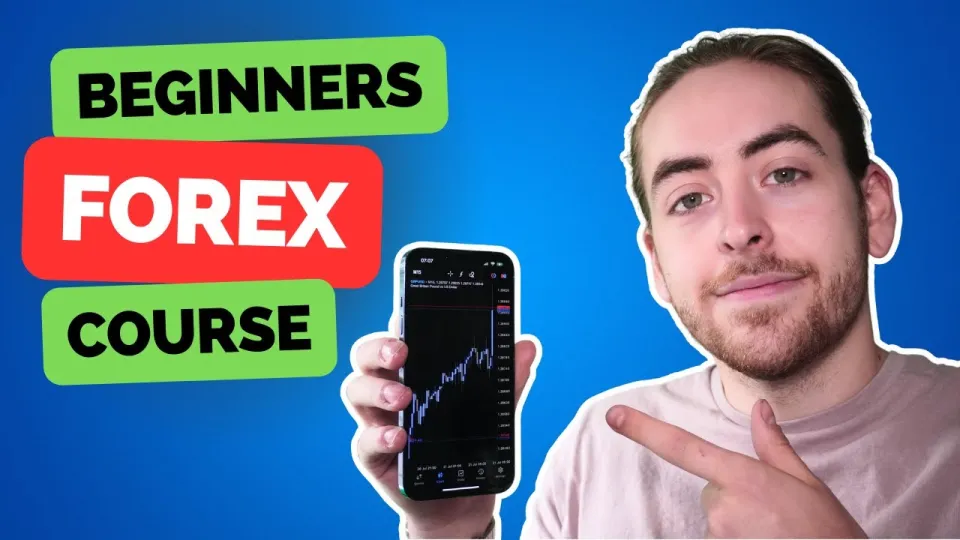
Video: Forex Trading For Beginners (FULL COURSE)
Want articles like this for your own video to promote it on YouTube and Google? Order them through the Telegram bot @sat_sit_bot. Articles with your video embedded are written and posted by the bot itself — on popular topical sites (no ads). Free trial — 50 articles.
· based on the channel JeaFx
Key takeaways
- Forex is the exchange of currency pairs such as EUR/USD, where the price reflects one currency valued in another.
- Profit comes from the difference between entry and exit price, so a trader needs price movement in the chosen direction, not a salary from the broker.
- A trading account is opened through a regulated broker; leverage multiplies both potential profit and loss.
- A market edge is a repeatable rule set tested on historical data, not a feeling or a signal from a chat.
- Risk control of about 1% of the account per trade and a trading journal are the practical floor for surviving the learning phase.
Forex is the market where national currencies are exchanged in pairs, and a beginner's job is not to predict the future but to learn what is traded, how money is actually made, how a broker and account work, and how to test a repeatable edge on historical data before risking real capital. The full beginner course from JeaFx covers exactly this sequence, and the free class at jeafx.com/class is the entry point the author offers for traders who want to understand why most accounts lose. Anyone starting with a small deposit and no framework is effectively paying the market for lessons it will happily provide.
What forex is and what is actually traded
Forex is the over-the-counter market for exchanging one currency for another, and everything quoted there is a pair. The euro against the US dollar (EUR/USD), the British pound against the dollar (GBP/USD), the dollar against the Japanese yen (USD/JPY) are the most liquid examples, and the price on the screen simply says how much of the quote currency is needed to buy one unit of the base currency. There is no central exchange and no single building where this happens: banks, funds, brokers and retail traders interact through a network of liquidity providers, which is why forex runs around the clock from Monday in Asia to Friday in New York.
What a beginner trades is not a company or a share of anything. There is no dividend, no ownership, no earnings report. The only source of return is the change in the exchange rate, which is driven by interest rate decisions, inflation data, employment figures, central bank commentary and the broad risk appetite of global capital. That has one important consequence: a forex position is a bet on relative strength, so a trader must know both sides of the pair and which economic calendar events can move them.
How money is actually made in forex
Money in forex is made from the difference between the price at which a position is opened and the price at which it is closed, multiplied by the position size. If a trader buys EUR/USD at 1.0800 and closes at 1.0850, the move is 50 pips; with a standard lot of 100,000 units that is roughly $500 before costs, and with a mini lot of 10,000 units it is roughly $50. The same arithmetic works in reverse: a 50-pip move against the position produces the same loss. Nothing is created by the broker and nothing is paid out of a pool; one side of the trade simply wins what the other side loses, minus spreads and commissions.
That is why position sizing matters more than the direction call. A correct forecast with an oversized position can wipe an account, while a modest forecast with controlled size survives to be tested again. Costs are part of the equation too: the spread is charged on entry, swaps are charged on positions held overnight, and both quietly reduce the edge of a strategy that trades too often. The beginner's takeaway is unglamorous: profit is a function of pip movement, position size and cost, in that order of visibility.
Setting up a broker and a trading account
The broker is the intermediary that gives a retail trader access to the interbank price stream, and choosing one is a risk decision before it is a convenience decision. A regulated broker, supervised by a body such as the FCA in the UK, CySEC in Cyprus or ASIC in Australia, must segregate client funds and disclose its execution model. Offshore entities offering enormous leverage with no oversight are cheaper on paper and far more expensive in practice.
A sensible setup sequence looks like this:
- Verify the broker's regulation and the entity that will actually hold the account, not just the brand name.
- Choose an account type with a spread and commission structure you can measure, not the one with the biggest deposit bonus.
- Open a demo account first and trade the same strategy there that you intend to trade live.
- Fund a live account only with money whose loss would not change your life, and start with the smallest position size the platform allows.
- Check leverage limits, margin call rules and stop-out levels before the first trade, not after the first drawdown.
Leverage deserves its own warning. At 1:100, a $1,000 account can control $100,000, which means a 1% move against the position erases the entire balance. Leverage does not increase the probability of being right; it only shortens the time in which being wrong becomes final.
Building a market edge instead of collecting signals
A market edge is a specific, written rule set that has been tested on historical price data and shown to produce a positive result after costs. It answers four questions in advance: what setup must appear, where the entry is, where the stop loss sits, and where the position is closed or reduced. Price action patterns, support and resistance, session timing, trend filters and news avoidance are all legitimate ingredients, but none of them is an edge until it is defined precisely enough that two people reading the rules would take the same trade.
Backtesting is the step most beginners skip, and it is the step that separates a strategy from a hope. Take a chart, hide the right side, scroll forward candle by candle, and record every qualifying setup with its entry, stop, target and result. A few hundred samples across different market conditions tell you more about a rule set than any month of live trading on a small account. The video course points to a dedicated backtesting walkthrough for this exact process, and the logic is simple: a strategy that cannot be measured cannot be improved, only believed in.
Risk management belongs inside the edge, not next to it. A common framework caps risk at around 1% of the account per trade and sets a daily or weekly drawdown limit at which trading stops. With 1% risk, ten consecutive losses cost about a tenth of the account, which is painful but survivable; with 10% risk, the same streak is close to ruin.
Mindset, expectations and the questions beginners keep asking
Expectations are where most new traders lose before the market takes anything. A beginner with a $500 account and a plan to turn it into a living is not trading, they are gambling with a schedule attached. Realistic expectations start with the process: a defined edge, a fixed risk per trade, a journal of every setup, and a review of that journal at fixed intervals. The result follows the process, not the other way around.
The questions that come up most often in beginner communities tend to repeat. How much capital is enough to start? Enough that a 1% risk is a meaningful but survivable amount, and small enough that losing it does not affect your life. How long until profitability? Usually measured in months of deliberate practice and hundreds of logged trades, not weeks. Should a beginner trade a live account while learning? A demo account and a backtest first, then a small live account to experience real execution and real emotion. Is a strategy from a video enough? A video gives the framework; the testing, the journal and the discipline are the trader's own work.
Useful links
- jeafx.com/class — the class on why traders actually lose, referenced in the course description.
- jeafx.com/go — mentorship and guided trading path from the author.
- instagram.com/jeafx_ — the author's Instagram.
- t.me/therealjeafx — free Telegram community.
The bottom line
Forex for beginners is a sequence, not a secret: understand what a currency pair is, know exactly how pip movement and position size turn into profit and loss, choose a regulated broker, define and backtest a rule set, and cap risk at a level the account can survive. The full beginner course from the JeaFx channel walks through that sequence in order, from what is traded to mindset and next steps, and it is worth watching without skipping because each part depends on the previous one. The traders who last are not the ones with the best prediction; they are the ones who treated the market as a business with measurable inputs. Start with the free class at jeafx.com/class, then build the journal before building the position.
Source: Forex Trading For Beginners (FULL COURSE) · Markdown version
Questions & answers
How much money do I need to start trading forex?
There is no universal minimum, but the amount should be small enough that losing it does not change your life and large enough that a 1% risk per trade is a real number rather than a rounding error. Many beginners start on a demo account and a backtest first, then fund a small live account to experience real execution and real emotion. The size of the deposit matters far less than the risk framework applied to it.
Can I learn forex trading from free videos alone?
Free videos can give you the full framework: what is traded, how profit is calculated, how brokers work, how to define a setup and how to backtest it. What they cannot do is test the strategy for you or enforce discipline. A beginner still has to log hundreds of backtested samples and keep a journal of live trades, and that work is the part that turns information into an edge.
Why do most beginner forex accounts lose money?
The usual causes are oversized positions relative to the account, no written rule set, no backtesting, and expectations of fast returns that push traders into revenge trading after a loss. Costs such as spreads and overnight swaps also erode strategies that trade too frequently. A regulated broker, a fixed risk per trade and a journal address most of these failure points before they compound.
Is forex trading gambling?
It becomes gambling when the position size is not controlled, the setup is not defined in advance and the outcome is left to hope. It is closer to a probabilistic business when the trader has a tested rule set, a fixed risk per trade of around 1%, a drawdown limit and a record of every trade. The market itself is not a casino, but an account without rules behaves like one.